A system chosen for your process.
Your product, rate, dwell time, and accumulation needs guide the choice. We work through the tradeoffs between power & free, enclosed track, I-beam, hand-pushed monorail, and Over-N-Under conveyors with you.
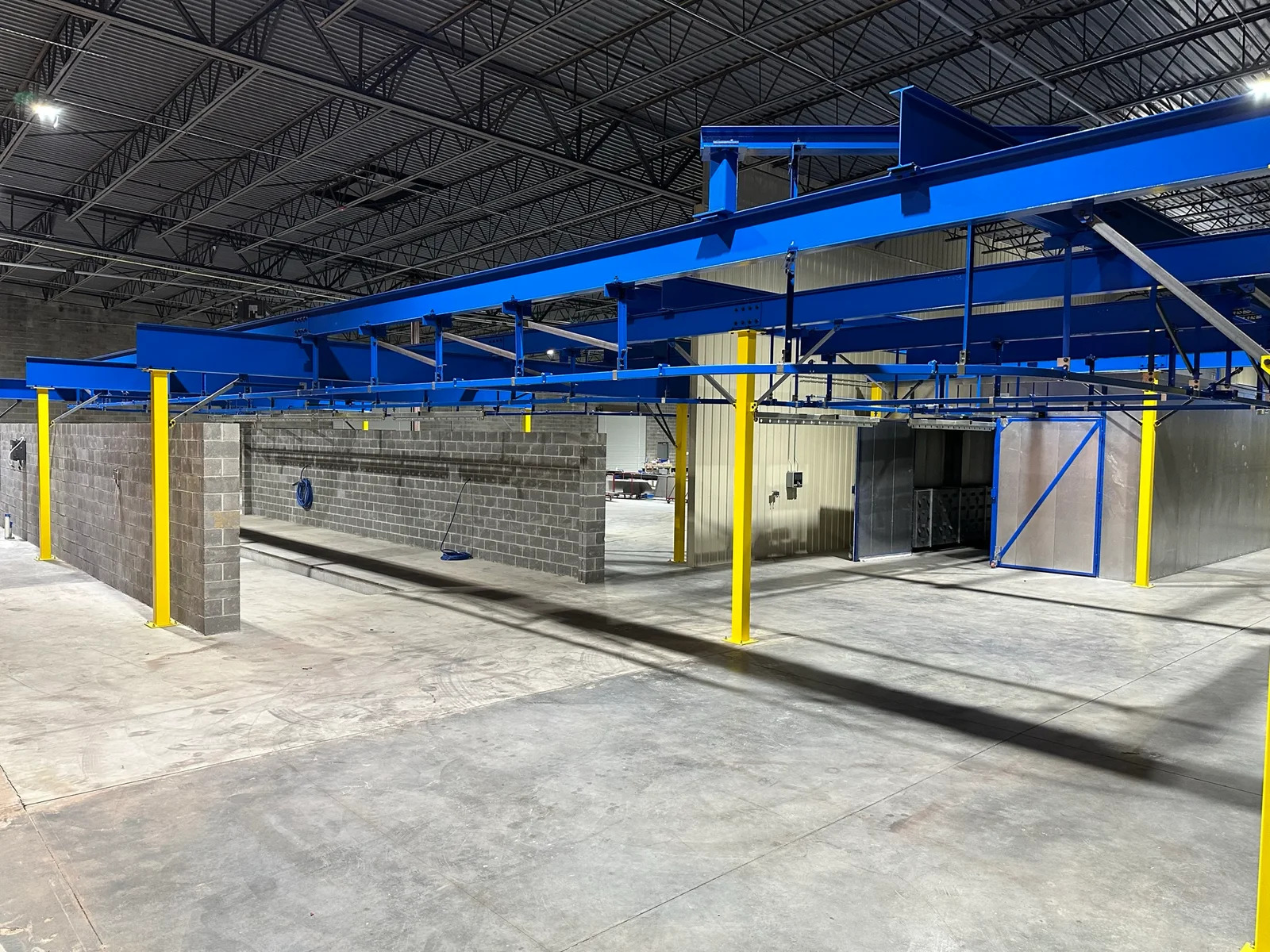
Get the overhead conveyor, support steel, and installation planned together. IMH designs, supplies, and installs overhead conveyor systems around your product, process, and plant.
Blue overhead conveyor track and support steel on yellow columns above an open production floor.
You need a line that fits the process, room for people to work, and a practical plan to get it installed. That is the conversation we bring to your conveyor project.
See it in an IMH projectYour product, rate, dwell time, and accumulation needs guide the choice. We work through the tradeoffs between power & free, enclosed track, I-beam, hand-pushed monorail, and Over-N-Under conveyors with you.
We plan the conveyor route and support steel together, considering column locations, aisles, operator access, and maintenance space. Bolt-together construction is considered where the application permits.
Delivery access, staging, lift paths, shutdown sequencing, and connections to finishing equipment belong in the early conversation. IMH brings conveyor and industrial installation experience to those decisions.
Maintenance access, replacement components, route changes, and future equipment moves affect the system you buy today. We also support conveyor maintenance, repair, and modernization projects.
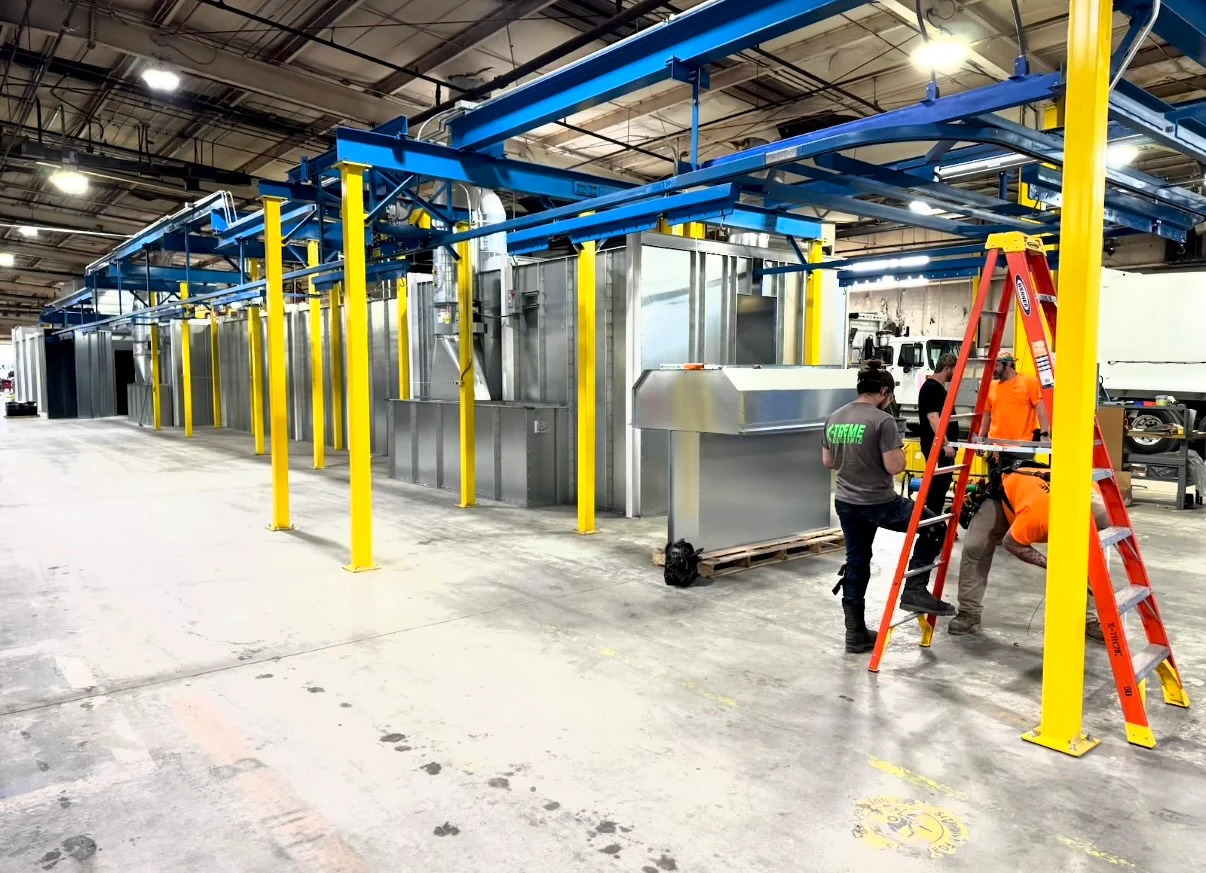
Design, fabrication, and installation of an enclosed-track conveyor integrated with an RTT paint system, including custom loadbars, support steel, and controls.
You can start with the process before you know the conveyor name.
Connect loading, coating, process dwell, and unloading around the part and its carrier.
Plan transfers, station timing, and accumulation around the people doing the work.
Use overhead accumulation and controlled release to accommodate different station times.
Review condition, compatibility, route changes, and the available installation window.
Need help with a fault or worn equipment? Discuss conveyor service
Start with how the product needs to move, then consider the track, carrier, and support arrangement.
Power & free describes carrier movement. Enclosed track and I-beam describe track construction; compatible versions can use power & free operation. The options below can overlap.
Find your starting pointIndependent carrier movement, accumulation, and routing between processes.
Compact overhead handling where the load and environment suit the track.
Suspended industrial loads where trolley duty, a rugged route, and service access shape the system.
Operator-controlled transfers along a defined overhead route.
Closed-loop part transfer or storage where an upper and lower route can suit the available space.
For products carried on belts, rollers, chains, slats, or carts, explore our floor conveyor systems.
Your project / Next step
For manufacturers planning a new line, expansion or change to an existing overhead conveyor. Start with the production problem; a completed specification is not required.
See an enclosed-track conveyor projectShare what you know. Leave unknown details open.
Email IMH salesStart with continuous movement, independent carrier stops, or manual transfer. Then review track construction and route. Enclosed track and I-beam describe construction; power & free describes carrier control, while Over-N-Under describes an upper-and-lower loop.
A useful conveyor budget starts with the loaded carrier, the route, and the work the line needs to perform. Two conveyors of the same length can require very different equipment and installation scopes.
Share a rough layout and production goal so we can discuss the assumptions behind an initial budget. Confirm unresolved site conditions and scope boundaries as the project develops.
A conveyor quote is easier to evaluate when the work around the equipment is visible. Ask each supplier to identify what is included, what is excluded, and who owns the remaining work.
With IMH, bring the route, support structure, equipment interfaces, and field installation into the same planning conversation. Define the responsibilities in the proposal before work begins.
Tell us where the current process slows down: repeated manual transfers, a station waiting for parts, limited accumulation, or a route that no longer fits the floor. We can discuss a new system, a modification, or a service need around the actual problem.
For an existing conveyor, share photographs, available drawings, equipment information, and the proposed change. Compatibility, condition, capacity, and support requirements need review before a modification is selected.
A useful first conversation does not require a finished specification. Bring a layout, product photo, rough sketch, or a description of the process. We will work through the open questions with you.
Look closer at the configurations that suit your production.
Share what you move, where it needs to go, and what is holding production back. A photo or rough layout is a useful start. You do not need a finished specification.
Discuss my conveyor project Work through the planning questions Complex flow or unknown rates? Explore an engineering study Or call (812) 363-1819