Overhead Conveyor Installation & Retrofit
Overhead conveyor installation and retrofit for active manufacturing facilities, including route changes, replacement sections, carrier updates, and support work.
Know who owns every interface.
Build the work around the site.
Agree what completion includes.
Bring clarity to the work.
Retrofit Work Is Never Just A Drawing
Overhead conveyor retrofit work has to account for what is already in the plant.
Existing supports, old track, drives, take-ups, carriers, controls, utilities, production equipment, and shutdown limits all affect what can be installed and how it should be phased. IMH focuses on practical field execution, not just replacement parts.
Retrofit Scope
Modify paths, add turns, change elevations, and plan tie-ins around existing conditions.
Replace worn track, vertical curves, supports, carriers, and high-wear areas when compatibility allows.
Improve part orientation, finish protection, ergonomics, spacing, obsolete controls, and process clearance.
What Makes Retrofit Work Difficult
Old drawings may be wrong, worn parts may hide deeper issues, and active equipment can block the easiest installation path.
IMH frames retrofit work around field verification, inspection gates, production impact, preassembly, phased demo, tie-in planning, startup checks, and punch-list control.
Before A Retrofit Quote
Better inputs lead to a more realistic retrofit plan.
Fix the right problem with the least unnecessary disruption to production.
Bolt-Together Structure Supports Future Retrofit Work
A welded support system can make future retrofit work harder because changes often require cutting, grinding, reworking, and refinishing the structure in the field. That adds disruption and can make a clean expansion or relocation more difficult.
IMH prefers bolt-together support structures where the application allows because they support tighter installation control and future flexibility. Sections can often be removed, modified, extended, or relocated more cleanly than a structure that was welded together as a one-time-use frame.
Retrofit Confidence
IMH has nationwide project proof around monorail upgrades, I-beam systems, hand-pushed monorail, and power and free work.
Maintenance guidance reinforces what retrofit buyers already know: worn track, chain stretch, frozen trolley wheels, overload conditions, lubrication, take-up travel, and inaccessible service points can all turn into production problems. IMH uses that field reality to build a practical path forward.
A strong retrofit does more than replace parts. It makes the system easier to run, service, and trust.
Can an old overhead conveyor be modified?
Often, but it depends on structure, components, controls, loads, and the requested change.
How much downtime is needed?
Downtime depends on demolition, tie-ins, access, electrical work, testing, and phasing.
Do you need drawings?
Drawings help, but photos and field review are also important.
How do I know if conveyor chain needs replacement?
Evaluate chain wear and elongation using the manufacturer’s measurement method and replacement criteria for the installed chain. Include lubrication, load history and operating condition in the review.
Can IMH replace only part of a conveyor?
That may be possible when compatibility, alignment, supports, and controls allow it.
Can a retrofit improve maintainability?
Yes. Retrofit work can improve access to drives, take-ups, inspection points, carriers, and high-wear sections.
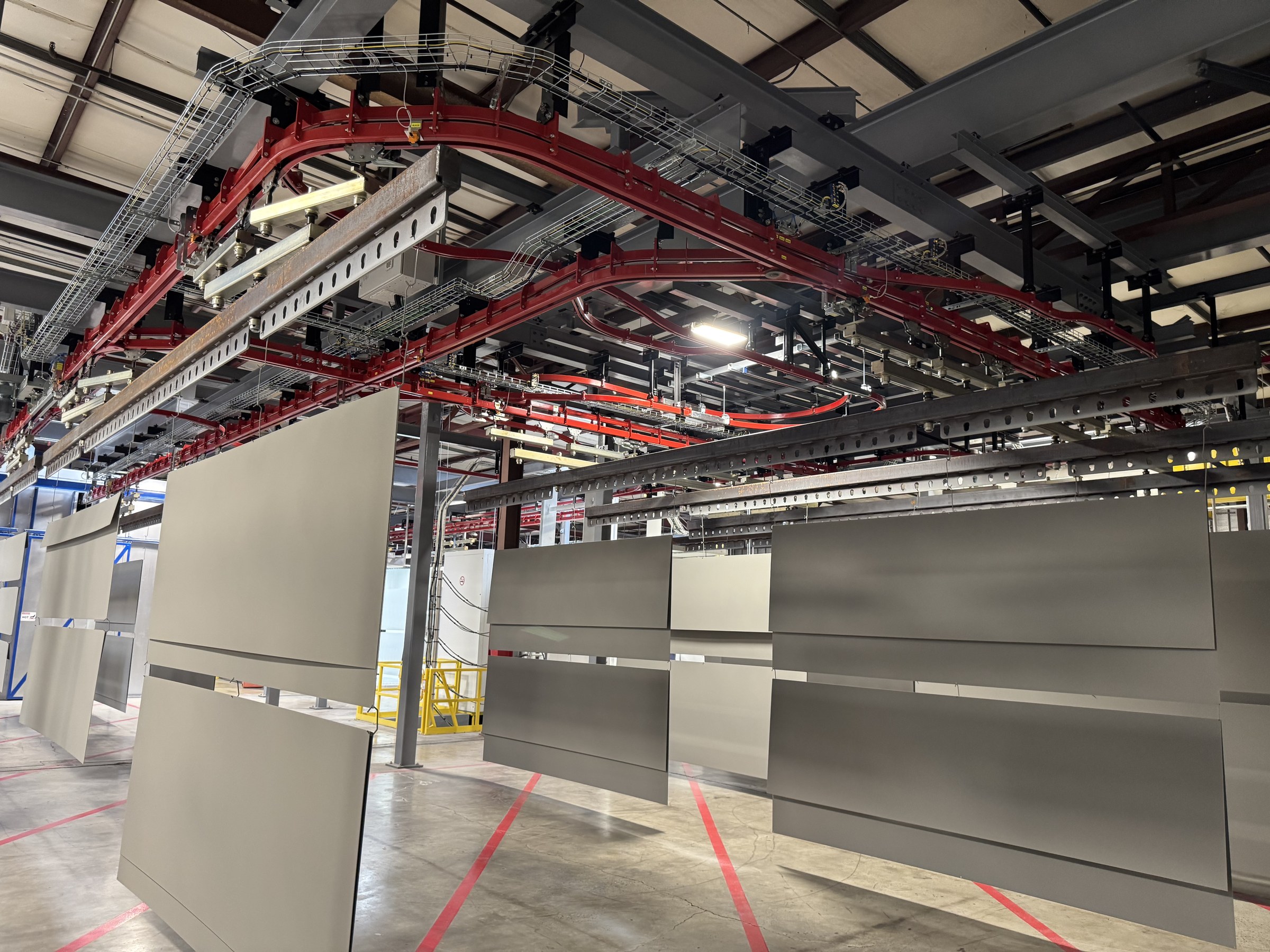
Power & Free. Installed for the Project Team.
Installation of a supplied power-and-free conveyor, with field layout coordination and overhead equipment integration in a finishing area.
- IMH responsibility
- Installation · design and equipment supplied by others
A field scope that fits.
Define delivery, access, assembly, utilities, and handover with the project team.
Your equipment.
A clear installation plan.
Tell us what is being installed, who supplies the equipment, and the site conditions. Build a brief around access, timing, field responsibilities, and handover.
Plan your installation Or call (812) 363-1819