
Over-N-Under Conveyor Systems
Compare Over-N-Under conveyor arrangements for upper-and-lower closed-loop transfer and storage. Review carriers, available height, loading and release needs.
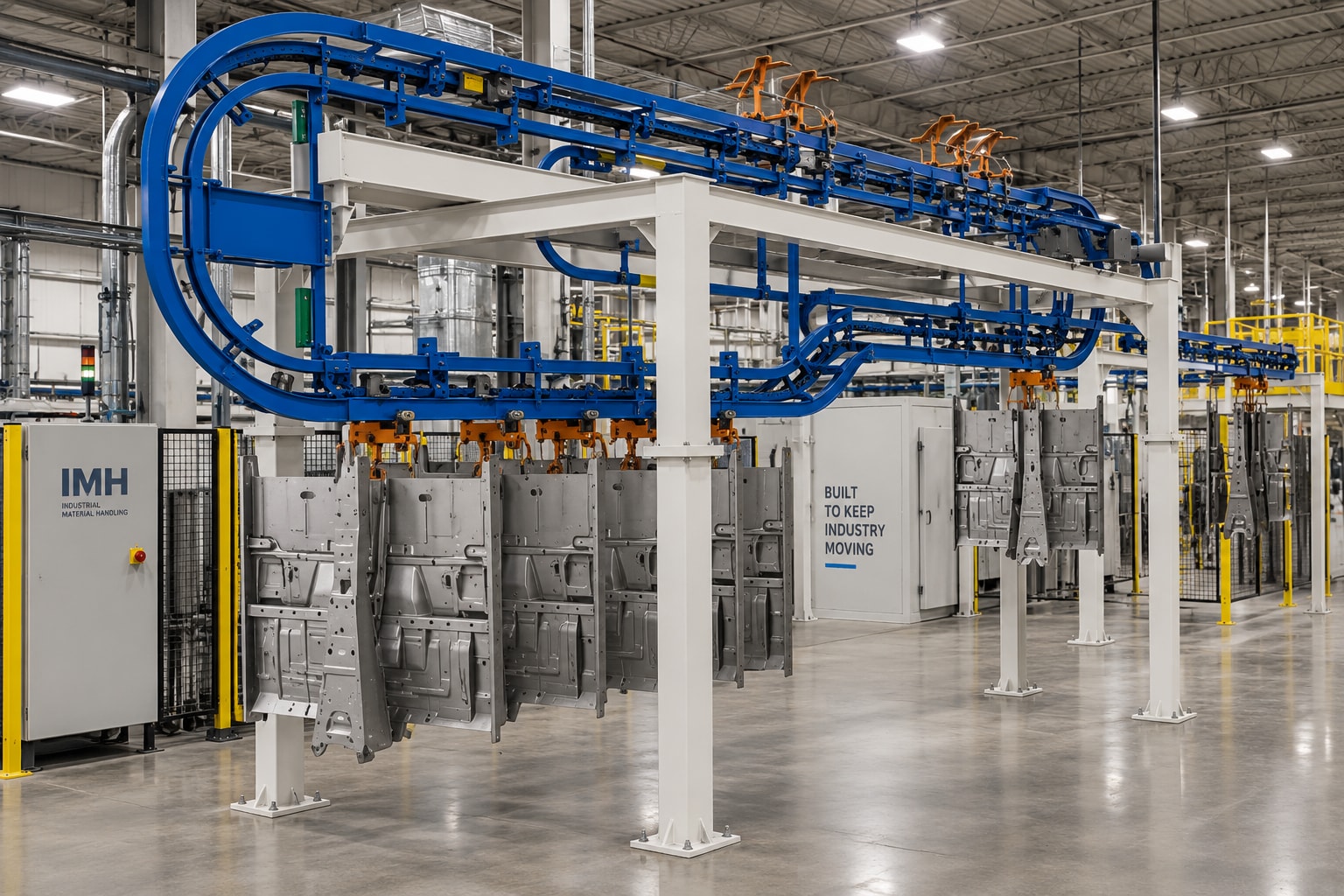
Over-N-Under system view: upper and lower conveyor runs arranged in a vertical loop, with suspended parts below.
Choose around the work you need to move.
Plan the route and support steel together.
Bring installation into the first plan.
The details shape the system.
A loop for part transfer and storage.
An Over-N-Under conveyor places upper and lower runs in a closed loop. The arrangement can transfer parts between defined points, provide storage, or combine both while making use of available vertical space.
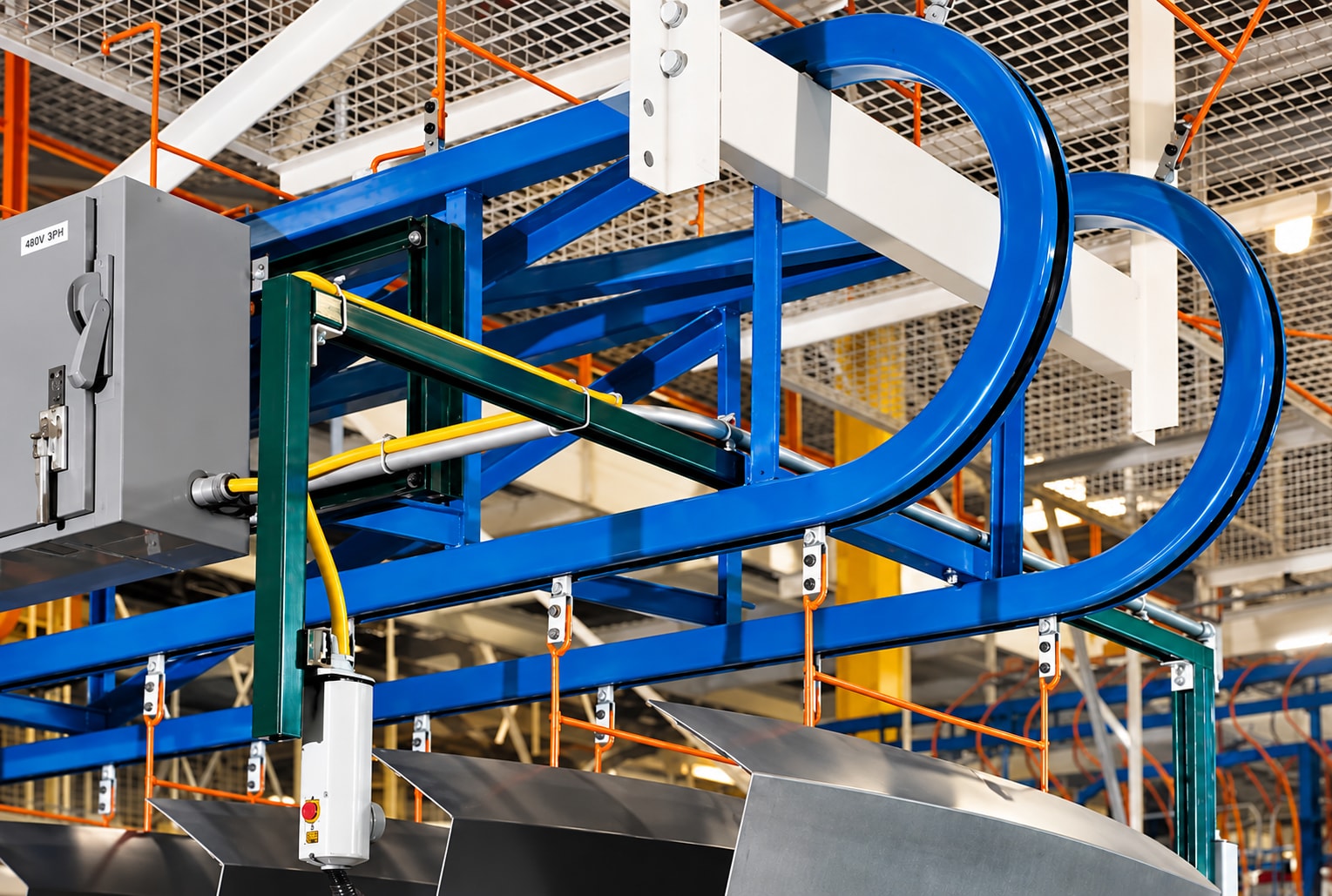
The load and return paths work together. In the gravity-flow arrangement, loaded carriers travel along the lower rail and empty hooks return above. Power & free arrangements can use the upper section for empty-carrier storage while maintaining a supply of carriers below.
The right arrangement depends on the part envelope, loading method, available height, and accumulation needs. These details guide the carrier design, support structure, and operating method.
Choose the arrangement around the work.
Daifuku’s Unibilt brochure describes four arrangements. Tandem uses adjacent synchronized loops; it is an arrangement of the conveyor rather than a separate source of power.
| Arrangement | How it moves | What to discuss |
|---|---|---|
| Gravity flow | Product weight and a pitched route advance the load; empty hooks return above. | Load consistency, loading and unloading elevations, and controlled movement. |
| Powered | A drive moves parts from load to unload; horizontal turns and vertical curves can route around aisles and obstacles. | Rate, clearances, and the path around aisles or equipment. |
| Tandem | Synchronized adjacent loops support a wider load arrangement. | Load width, stability, and carrier design. |
| Power & free | Separate power and carrier tracks support accumulation and independent loading or unloading. | Required queue, release sequence, controls, and empty-carrier storage. |
Confirm the loop fits the transfer.
Storage is a requirement to define, not enough on its own to select an Over-N-Under. Confirm that the upper-and-lower return path, loading points and available height suit the work.
Review the loaded carrier through the end transitions and any curves. If the process needs multiple destinations or extensive routing beyond the loop, compare a broader power & free layout.
Bring the part and the process.
Start with what needs to move and what the transfer or storage area needs to achieve. IMH can discuss the conveyor arrangement, support steel, access, and installation scope together.
- Part and loaded-carrier dimensions, weight, and orientation
- Pickup and discharge points, available height, and floor access
- Required rate, storage quantity, and operator tasks
- Surrounding equipment, support conditions, and installation timing
Selected manufacturer reference.
The brochure illustrates the four arrangements and their component context. Use it for preliminary comparison; the final equipment and layout are selected for the application.
Download the Unibilt Over-N-Under brochure (PDF, 4 pages)
Unibilt Over-N-Under brochure (PDF) Daifuku Automotive America · January 2024 · Bulletin 8089; PDF pp. 2–3
Explore the arrangements.
Look closer at the configurations that suit your production.
Bring us the bottleneck.
We’ll help plan the movement.
Share what you move, where it needs to go, and what is holding production back. A photo or rough layout is a useful start. You do not need a finished specification.
Discuss my conveyor project Work through the planning questions Complex flow or unknown rates? Explore an engineering study Or call (812) 363-1819