Every transfer. Every process. One considered system.
Your production goal reaches beyond a single piece of equipment. We plan the material flow, handling, controls interfaces, and installation around how your whole plant needs to work.
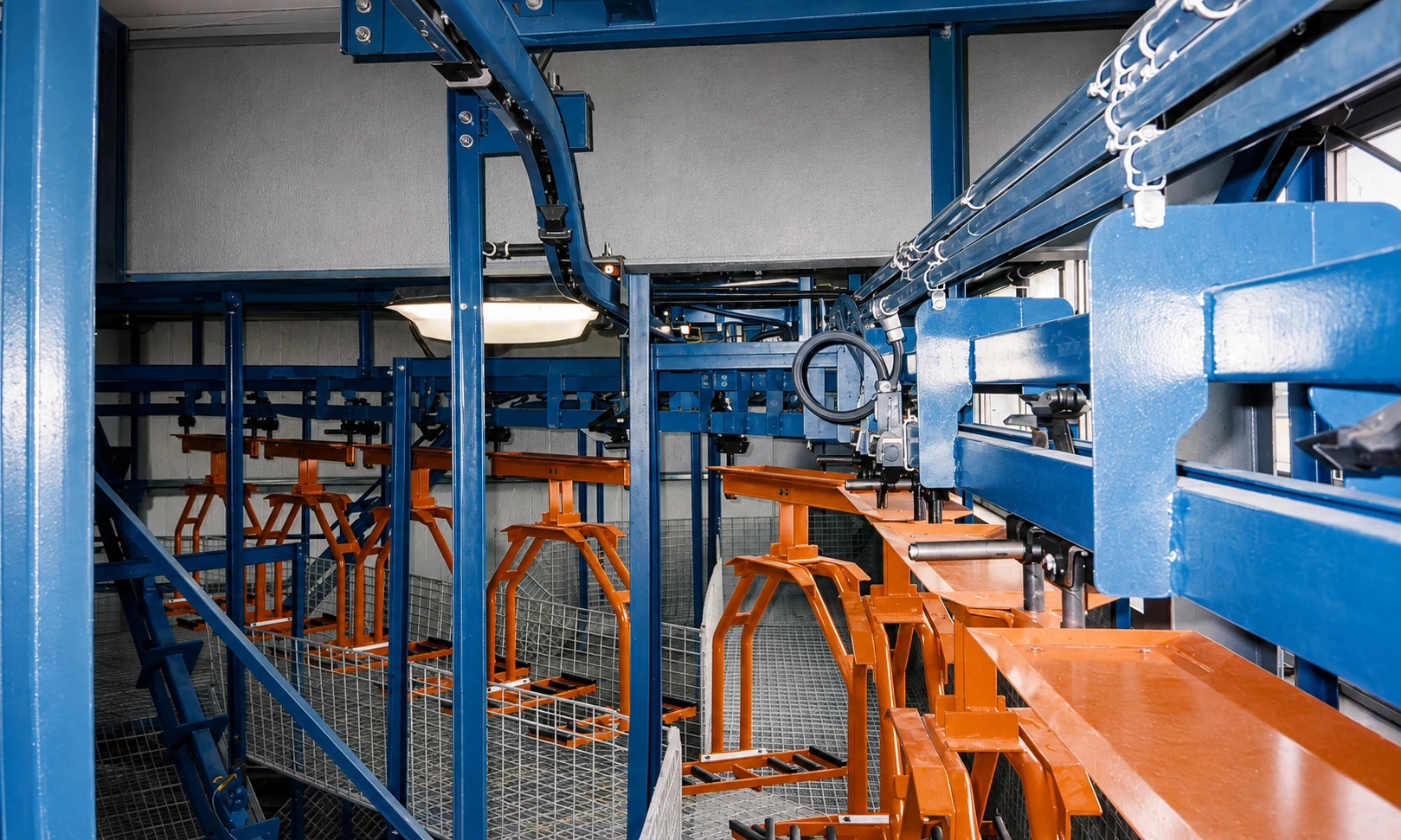
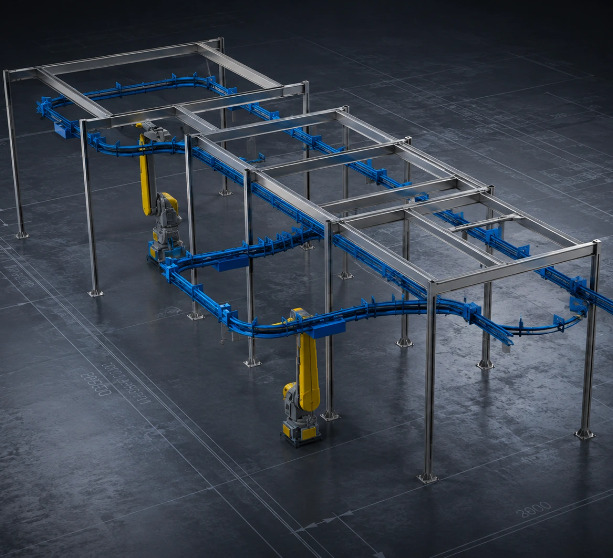
Uni/3" Power and Free with custom carriers3D system visualization
The system perspective
Every detail. Part of a bigger plan.
01 / Follow the whole flow
IMH designs with the whole system in mind.
Capacity at one step means little if the next step cannot keep up. The handoffs between processes deserve as much attention as the equipment itself.
MATERIAL FLOW / CONCEPT DIAGRAM
01Receiving
02Staging
03Production
04Finishing
05Packing
06Shipping
Queue builds before the constraintPRODUCT + PROCESS + ROUTE + CONTROL
01Receiving
02Staging
03Production
04Finishing
05Packing
06Shipping
Queue builds before the constraint
The line moves. The plant waits.
Material collects ahead of a limiting process. Increasing the incoming feed alone can build a larger queue while downstream operations wait for work.
Material in motion Accumulating material
Illustrative flow concept, not a simulation or performance prediction. Actual layouts, process steps, and results depend on your application.
We engineer material handling around your process equipment and coordinate the interfaces with your team and equipment suppliers. The project scope defines who supplies each system and service.
02 / Engineering studies
Know what to build. Before you commit to building it.
For a complex custom solution, the first investment is understanding the system.
When rates, routes, or requirements are unresolved, meaningful engineering comes before a meaningful project quote. A paid IMH engineering study turns those open questions into a documented basis for your next decision.
Understanding the detail shapes the bigger decision.
01Establish the requirements.
Define what the system needs to achieve.
02Generate Concepts
Using your criteria, develop concepts with estimated price and performance.
03Invest with a clearer basis.
Using the concepts generated, enable an informed execution plan.
Without that groundwork, a quote may rest on incomplete assumptions about equipment, interfaces, or the work required on site. The study addresses all the gaps upfront, reducing change orders and delays during project execution.
03 / When to start with a study
Big changes. Unanswered questions.
A study is most useful when the solution is custom, the interfaces are complex, or the data needed to define it is missing.
01
You want a real concept and real numbers before committing.
Seeing a real concept, execution timeline, projected cost, and planned performance enables committing to a large project safer. Our team will understand your requirements, constraints, and goals and develop the most appropriate solution for you.
02
You need substantially more output.
Find the process that limits finished output. Evaluate the handling, process capacity, staffing assumptions, and downstream changes needed to support the target.
03
Your products or changeovers are changing.
Examine different sizes, weights, fixtures, routings, batch sizes, and changeover requirements before committing to a layout. Our team can help plan your plant expansion with uncertainty in mind.
04
You’re connecting old and new.
Plan automation, manual transfers, existing machinery, new equipment, and controls interfaces as a connected operation.
05
The plant itself is a constraint.
Evaluate expansion, relocation, floor space, access, maintenance clearance, and how installation can fit an operating plant’s shutdown window.
04 / What you take forward
A decision package. With substance.
The study is a defined engineering deliverable. You receive the findings and recommendations agreed in its scope, with the basis for the next decision documented.
CONCEPT → DECISION → PROJECT
Detailed fabrication drawings and final project engineering follow in the next phase unless separately contracted.
IMH / ENGINEERING STUDYYour decision package
01
Operating requirements
A documented basis of design: products, operating conditions, production goals, known inputs, and assumptions still to verify.
02
Rates & constraints
A current and target rate assessment using the agreed data collection scope, with limiting steps, variability, and dependencies identified.
03
Concept material-flow layout
A considered route through the operation, including transfers, accumulation, access, and the relationship between process areas.
04
Options & a recommended approach
Practical alternatives and tradeoffs, so the preferred direction has a clear engineering rationale.
05
Equipment & controls interfaces
The key handoffs between systems, with responsibilities, site requirements, and integration questions made visible.
06
A basis for the project proposal
An agreed concept and defined requirements that inform the next phase of scope, engineering, and project pricing.
The right level of engineering
A straightforward system? Start with a quote.
A separate paid study is not a prerequisite for every project. If your technical data is complete or the application is well defined and less complex, we can often move directly into application review and quoting.
Many monorail applications
Hand-push and straightforward handling systems
Clearly defined systems with sufficient technical data
Normal application and project engineering still apply. Complexity, interfaces, and unresolved requirements determine whether a separate study adds value.
Bring the production goal. We’ll work through the system.
A rate you need to reach. A product change. A flow problem you cannot yet explain. Start with what you know; identifying the missing information is part of the conversation.