
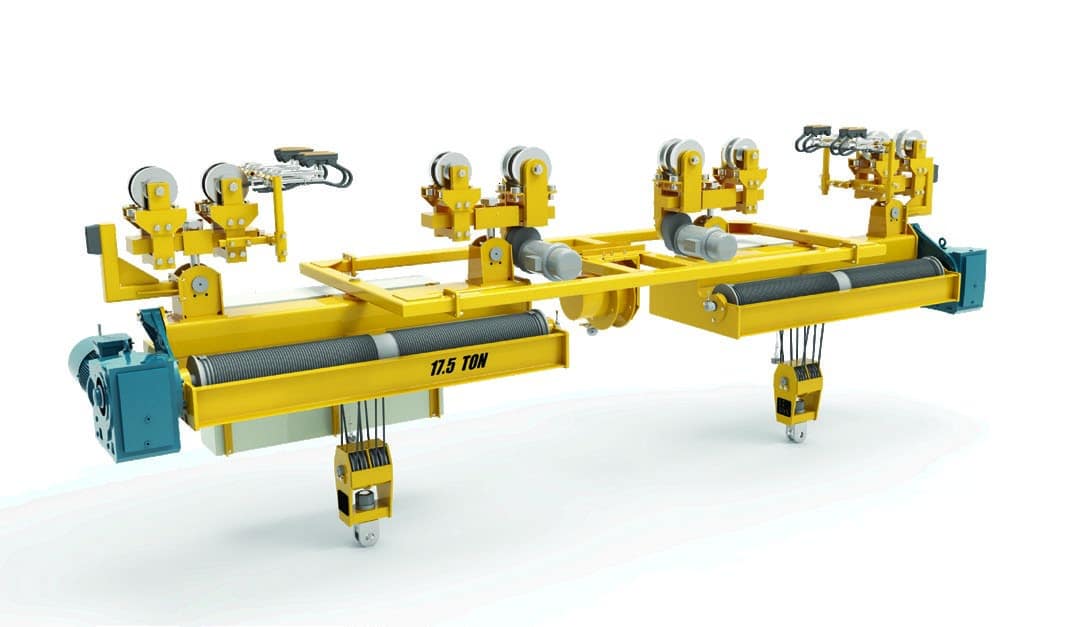
Powered Carrier Hoist Monorail Systems
Powered hoist-carrier monorails move discrete suspended loads along engineered overhead rail using motorized trolleys, dedicated tractors, or application-specific powered carriers with hoists, routing hardware, electrification, and controls selected for the project.
Not A Standard Conveyor Monorail
A powered hoist-carrier monorail is a routed lifting and transport system. Carrier travel may use a motorized trolley, a dedicated drive tractor, or an application-specific powered arrangement, allowing discrete loads to move through a defined route without being mechanically tied to one continuously moving chain circuit.
The carrier is commonly equipped with a hoist for lifting, lowering, pickup, and placement, although applications can use a load-specific carrier without a hoist. That combination places this equipment between a crane and a conveyor: it provides crane-style lifting on a defined overhead path with separately controlled hoist and travel functions.
What Makes The System Different
Powered Carrier Travel
Motorized trolleys, dedicated drive tractors, and application-specific carrier arrangements support powered travel without mechanically tying every load to one continuous chain circuit.
Hoist-Equipped Movement
An onboard hoist can lift and lower the load at pickup, process, assembly, maintenance, or placement points. Load-specific carriers can also be used when vertical lifting is not required.
Routed Overhead Travel
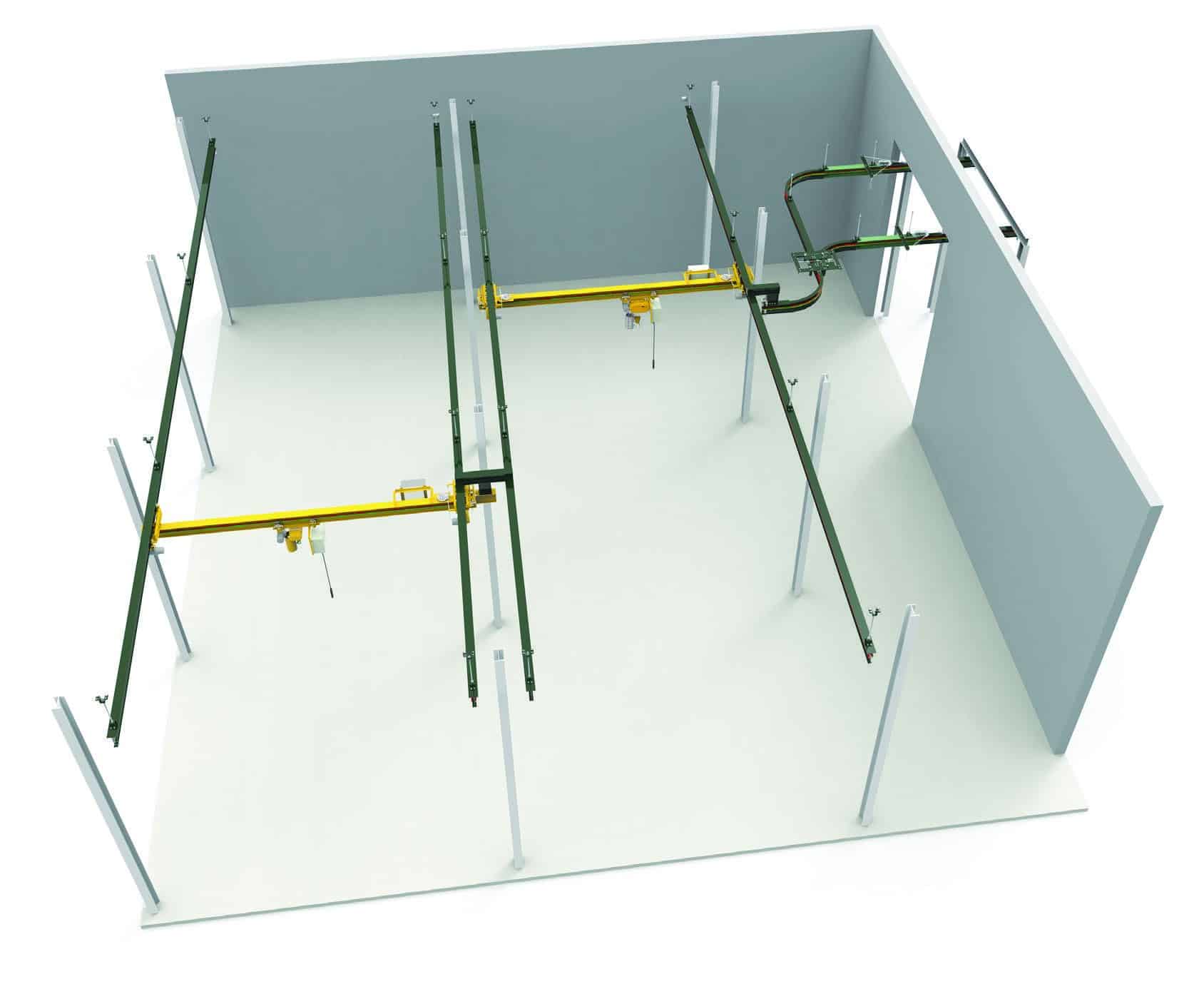
Curves, switches, interlocks, and transfer points can create controlled paths between bays, work cells, process stations, storage positions, and crane coverage areas.
A Crane-Conveyor Hybrid For Individually Controlled Loads
A bridge crane provides broad hook coverage within a bay. A chain-driven overhead conveyor moves carriers together through a repeating route. A powered carrier hoist monorail serves a different need: each load follows a defined path but can move and lift independently.
That makes the system useful when loads are too heavy, valuable, variable, or process-sensitive for conventional conveyor movement, yet still need repeatable travel between specific destinations rather than full rectangular bridge-crane coverage.
Start With A Buildable Plan
Before budget, downtime, or engineering time is committed, the right project details need to be clear. IMH connects the desired outcome with the field conditions that decide whether the system can be installed cleanly and perform reliably after startup.
That means collecting photos, drawings, measurements, production goals, safety requirements, shutdown limits, and maintenance concerns early. It also means explaining tradeoffs in plain language: what should be engineered now, what can be phased later, what needs structural review, and what information is still missing before a final recommendation is responsible.
Powered Hoist Monorail Versus Continuous-Chain Monorail
The word monorail describes the path, not the operating method. These differences separate powered hoist-carrier systems from continuous-chain-towed conveyor monorails without confusing them with power-and-free conveyor technology.
| System characteristic | Powered hoist-carrier monorail | Continuous-chain monorail |
|---|---|---|
| Travel drive | Travel uses a motorized trolley, dedicated tractor, or application-specific powered carrier. | Interconnected trolleys are pulled through a common chain circuit. |
| Vertical lifting | An onboard hoist is typical, but a load-specific carrier can be used without one. | The load normally hangs from a carrier or load bar at a fixed elevation. |
| Movement control | Discrete loads can receive separately commanded hoist and travel motion where the control architecture requires it. | Speed and spacing generally follow the common chain circuit. |
| Routing hardware | Curves, switches, interlocks, and transfers support selected destinations and connected paths. | Curves and routing are designed around the conveyor chain and carrier path. |
| Best fit | Heavy or valuable loads, independent lifts, variable destinations, assembly, maintenance, and process movement. | Repeatable production flow, accumulation, finishing, assembly, or continuous material movement. |
Where Powered Carrier Hoist Monorails Fit
The strongest applications combine a defined route with the need for individual travel, controlled lifting, or multiple destinations.
The Route, Carrier, Controls, And Structure Are One System
Carrier capacity alone does not define a powered hoist monorail. IMH reviews load weight, center of gravity, lifting points, hoist motion, carrier wheel loads, route geometry, curves, switches, interlocks, travel speeds, power delivery, controls, support steel, building clearances, maintenance access, and installation sequencing as one coordinated scope.
Available component families include two-, four-, and eight-wheel trolleys, motorized trolleys, drive tractors, curved rail, switches, turntables, crossovers, interlocks, expansion provisions, conductor-bar electrification, and flexible suspension. Source configurations show trolley capacities from 1,500 to 16,000 pounds, end trucks up to 60,000 pounds, and powered travel examples from 28 to 600 feet per minute using 1/3 to 5 horsepower motors. These are product-family examples, not universal IMH limits; final capacity, speed, drive power, rail, hoist, controls, and support spacing are project-engineered.
Engineered Routing For Discrete Lift Loads
Powered hoist-carrier monorails belong in the overhead lifting family because the equipment is engineered around lifted capacity, wheel loads, rail strength, hoist duty, carrier travel, transfer geometry, electrification, and controls.
The route can connect curves, switches, turntables, crossovers, interlocks, track-opening sections, and compatible crane bridges when the project requires more than a straight point-to-point path.
For bridge crane and overhead lifting projects, that means reviewing capacity, span, hook coverage, runway support, lift height, duty cycle, controls, electrification, building structure, access below the crane, and installation phasing before recommending a path.
The result should be a crane system that can be quoted responsibly, installed cleanly, aligned correctly, operated confidently, and serviced after startup.
Designed, Built, And Installed As A Complete Material Handling System
IMH develops the operating concept, defines the carrier and lifting requirement, plans the route and support structure, coordinates controls and electrification, and installs the equipment around the real facility conditions.
The customer receives one project conversation focused on the finished system: how the load is picked up, where it travels, how each carrier is controlled, what supports the route, how the installation is phased, and what is required for testing and startup.
A powered hoist monorail is not a conveyor with a different name. It is a routed lifting system engineered around the load, carrier drive, hoist, destinations, controls, rail, and building.
Frequently Asked Questions
Is this the same as a continuous-chain conveyor monorail?
No. A continuous-chain monorail pulls interconnected trolleys through a common chain circuit. A powered hoist-carrier monorail uses motorized trolley or tractor travel and commonly includes an onboard hoist for discrete lifting and movement. Power-and-free conveyor is a separate conveyor architecture and should be evaluated on its own.
Does every carrier need a hoist?
No. Hoists are typical when the load must be lifted or lowered, but the carrier can be designed around a load-specific attachment when vertical motion is not required.
Can carriers travel to different destinations?
Yes. Depending on the route and controls, switches, interlocks, branches, and transfer points can direct individual carriers to selected work areas.
Can the system connect with cranes or other monorails?
It can be designed with interlocks or transfer arrangements when loads need to move between compatible overhead lifting paths. The interface must be engineered around alignment, load transfer, power, controls, and safety.
What capacities and speeds are available?
Powered carrier systems can be configured for demanding industrial loads and a wide travel-speed range. IMH validates capacity, drive power, speed, duty, rail, trolley arrangement, and hoist requirements for the specific project.
What should I send for a project review?
Send the maximum load, part dimensions, lifting points, pickup and drop-off elevations, route sketch, destinations, desired travel behavior, building photos or drawings, duty, controls expectations, and installation timing.
Review A Powered Carrier Hoist Monorail Project
Send IMH your load details, pickup and drop-off points, route, destinations, lifting needs, building information, and production goal. We will help determine whether an individually driven hoist monorail, bridge crane, or conveyor system is the right solution.