
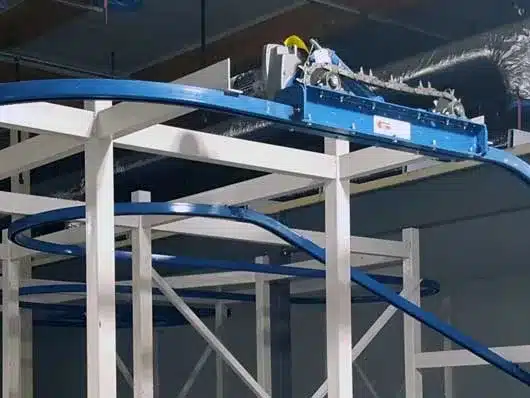
Enclosed Track vs Heavy-Duty Trolley Conveyor
A practical comparison of compact enclosed-track conveyor and heavy-duty overhead trolley chain conveyor systems for buyers weighing load, routing, operating method, environment, support steel, service access, and retrofit needs.
The Short Answer
Enclosed track is often considered for clean, compact routing with lighter to moderate loads. A heavy-duty overhead trolley chain conveyor is often considered for heavier loads, rugged environments, longer runs, and applications where durability and serviceability matter.
The heavy-duty system commonly uses American Standard S-shape beam track with tapered flanges. It is frequently marketed across the industry as an I-beam conveyor, but IMH evaluates the actual track, trolley, chain, carrier, drive, and duty. The correct choice also depends on process timing, curves, elevation, support steel, maintenance access, and what is already in the plant.
How The Two Options Differ
Enclosed Track
Compact track, cleaner routing, lighter to moderate loads, and useful turns when the application fits.
Heavy-Duty Trolley Chain
Powered, power-only movement on rugged S-beam track for heavier loads, harsh environments, long routes, and accessible wear components.
Power And Free
Either comparison may change when the project needs accumulation, switches, stops, or independent carrier behavior.

Do Not Compare Track Alone
Track shape is only one part of the system. Carrier spacing, support steel, drive and take-up location, lubrication, controls, part orientation, and installation access can decide whether a conveyor works well.
For retrofit projects, the existing structure, old route, worn parts, and shutdown limits may matter more than the ideal new-system comparison.
Start With A Buildable Plan
Before budget, downtime, or engineering time is committed, the right project details need to be clear. IMH connects the desired outcome with the field conditions that decide whether the system can be installed cleanly and perform reliably after startup.
That means collecting photos, drawings, measurements, production goals, safety requirements, shutdown limits, and maintenance concerns early. It also means explaining tradeoffs in plain language: what should be engineered now, what can be phased later, what needs structural review, and what information is still missing before a final recommendation is responsible.
Enclosed Track vs Heavy-Duty Trolley Comparison
Use this table to frame the decision before IMH reviews the application details.
| Factor | Enclosed track | Heavy-duty trolley chain |
|---|---|---|
| Typical load profile | Lighter to moderate loads where compact routing and clean movement are priorities. | Heavier loads and more rugged applications where durability is central. |
| Route style | Compact turns, cleaner layouts, and efficient overhead space use. | Longer runs, heavier carriers, and rugged production areas. |
| Environment | Good fit for cleaner applications when component selection and maintenance match the process. | Often considered for harsher environments, fabrication areas, heat, dust, or abuse. |
| Maintenance | Service access still matters for drives, take-ups, chain, carriers, and inspection points. | Open components can make wear points and trolley/chain inspection more direct. |
| Support steel | Can be compact but still needs support planning to preserve floor access. | Requires serious support review around loads, spans, bracing, and floor impact. |
| Retrofit fit | Useful when a compact route can be added around existing equipment. | Useful when replacing or upgrading aging monorail sections or heavier systems. |
Questions That Decide The Comparison
The right answer usually emerges from application details, not a brand or track preference.
Both Choices Need Real Support Planning
Enclosed track can still create clutter below the line if the support layout is weak. A heavy-duty trolley conveyor can still fail the plant if the structure is overbuilt in the wrong places.
IMH treats support steel as part of the conveyor decision so the final system carries the load and preserves useful production space.
The Work IMH Is Built Around
IMH Systems is focused on engineered movement overhead, reliable lifting, and field execution inside real manufacturing plants. Overhead conveyors, bridge cranes, and service or installation work remain the center of that story, while secondary equipment is included only where it helps solve the larger project.
Buyers get practical answers instead of generic product language: what details matter, what decisions affect the installed system, what tradeoffs need review, and when a project is ready for a deeper conversation.
For conveyor projects, that means reviewing load weight, carrier behavior, drive and take-up locations, controls, support steel, access below the line, maintenance points, and shutdown phasing before recommending a path.
A strong system can be quoted responsibly, installed cleanly, and serviced after startup.
Comparison Content That Feeds Product Pages
This comparison connects enclosed track, heavy-duty trolley chain conveyor, and the main overhead conveyor selection guide for buyers who are deciding between system types.
It captures buyers who are already comparing options and helps route them toward a project review rather than a generic catalog page.
Enclosed track and heavy-duty trolley chain systems solve different problems. The load, process, and plant decide.
Frequently Asked Questions
Is enclosed track cheaper than a heavy-duty trolley conveyor?
Cost depends on load, route, support steel, controls, carriers, installation, and maintenance needs.
Which is better for heavy loads?
A heavy-duty trolley chain conveyor is often considered for heavier or more rugged applications, but the final answer requires load, process, drive, and structure review.
Which is better for tight spaces?
Enclosed track can be strong for compact routing when the load and environment fit.
Can either system be power and free?
Power and free behavior depends on the conveyor family and engineered layout; controls, stops, switches, and carriers must be reviewed.
Can IMH retrofit either type?
Yes. IMH can review existing enclosed track, S-beam trolley conveyor, support steel, carriers, controls, and replacement sections.
Ready To Compare Conveyor Types?
Send IMH your load, route, photos, environment, and installation timing so we can help compare the right path.