
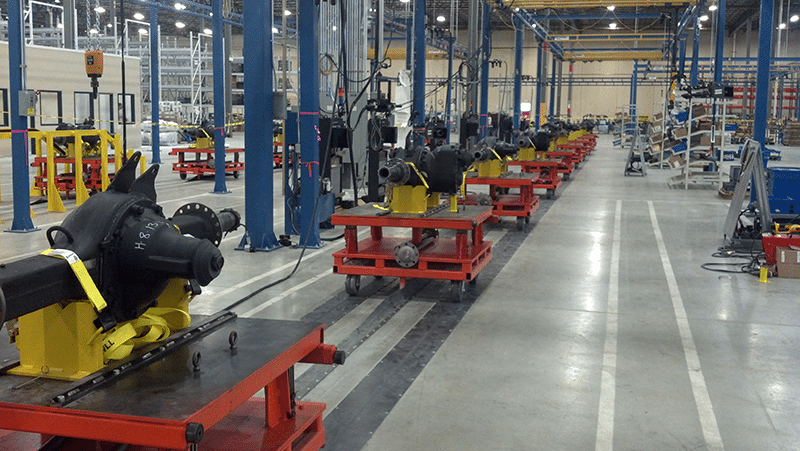
Towline Conveyor Systems
Towline conveyor systems for repeatable cart and fixture movement, heavy assembly flow, generator skid production, large equipment manufacturing, live storage, indexing, accumulation, and controlled floor-level routes.
Towline Works When Heavy Carts Need A Controlled Path
Towline conveyor is a serious floor-level solution when carts, fixtures, skids, or large assemblies need to move through production with less random traffic and more predictable pacing. It can support assembly lines, order picking, live storage, finishing support, inspection flow, test staging, and shipping preparation when the route is planned correctly.
This is especially relevant for manufacturers building large industrial equipment: generator skids, enclosures, tanks, frames, specialty vehicles, machinery bases, and mission-critical power equipment. IMH does not force towline into every plant, but when floor-level cart movement is the right fit, towline deserves to be treated as a lead product instead of a secondary floor conveyor option.
Towline Planning Priorities
Cart, Fixture, And Load
Cart size, tow pin, load surface, racks, fixtures, roller beds, turntables, tilt tops, and loaded center of gravity affect the design.
Stops, Spurs, And Indexing
Powered or non-powered spurs, stops, lockouts, accumulation, release points, and dispatch logic shape how carts move through the route.
Track, Concrete, And Maintenance
Track depth, chain path, roller turns, cleanout access, wear bars, drive location, and shutdown work affect installation and long-term use.

Heavy Assembly Flow Without Random Floor Traffic
Data center growth is pushing demand for large generator packages, power enclosures, switchgear-adjacent equipment, fuel systems, cooling packages, and other mission-critical industrial products. The manufacturing challenge is not only lifting the load. It is moving large workpieces through assembly, inspection, test, rework, paint, staging, and shipping without turning the plant into a forklift maze.
Towline can give those large builds a repeatable path while still allowing operators to work around the product. Deep in-floor systems, low-profile towline concepts, powered spurs, accumulation zones, and dispatch points should be selected around the actual cart, route, load, floor, controls, and maintenance requirements.
Start With A Buildable Plan
Before budget, downtime, or engineering time is committed, the right project details need to be clear. IMH connects the desired outcome with the field conditions that decide whether the system can be installed cleanly and perform reliably after startup.
That means collecting photos, drawings, measurements, production goals, safety requirements, shutdown limits, and maintenance concerns early. It also means explaining tradeoffs in plain language: what should be engineered now, what can be phased later, what needs structural review, and what information is still missing before a final recommendation is responsible.
Towline Conveyor Inputs
These details help define whether towline can move carts cleanly without creating traffic or maintenance problems.
| Input | Why it matters |
|---|---|
| Cart load and size | Defines cart design, tow pin, spacing, chain pull, stop locations, and floor clearances. |
| Fixture or skid design | Determines how generator packages, frames, tanks, enclosures, or machinery bases are supported and accessed. |
| Route and turns | Controls track layout, roller turns, spurs, switches, aisle conflicts, and installation work. |
| Accumulation and live storage | Determines stop logic, dispatching, cart spacing, and whether carts can queue safely. |
| Track depth | Separates low-profile needs from heavier-duty in-floor track requirements. |
| Controls and dispatch | Coordinates stops, sensors, release points, host-system needs, operator stations, and line status. |
| Maintenance access | Plans cover plates, cleanout areas, drive access, chain inspection, and downtime strategy. |
Best-Fit Towline Uses
Towline is strongest when repeatable cart flow solves a real plant movement problem.
A Towline Route Has To Live With The Plant
Towline is a floor-level decision, so it must be planned around people, forklifts, equipment access, cleaning, service, and future layout changes.
IMH reviews the track path, pits or surface requirements, cart behavior, controls, drive access, and shutdown work so the route can be installed and maintained responsibly.
The Work IMH Is Built Around
IMH Systems is focused on engineered movement overhead, reliable lifting, and field execution inside real manufacturing plants. Overhead conveyors, bridge cranes, and service or installation work remain the center of that story, while secondary equipment is included only where it helps solve the larger project.
Buyers get practical answers instead of generic product language: what details matter, what decisions affect the installed system, what tradeoffs need review, and when a project is ready for a deeper conversation.
For conveyor projects, that means reviewing load weight, carrier behavior, drive and take-up locations, controls, support steel, access below the line, maintenance points, and shutdown phasing before recommending a path.
A strong system can be quoted responsibly, installed cleanly, and serviced after startup.
Towline Planning Confidence
Towline can reduce aisle confusion, smooth material pacing, support live storage, and organize repeatable cart movement when the route is engineered correctly.
IMH positions towline as a strong product for serious floor-level applications while keeping the broader website clear: overhead conveyors are the primary floor-space solution, bridge cranes handle lifting coverage, installation ties the project to the field, and towline handles controlled cart or fixture movement when floor-level flow is the right answer.
A towline system should make cart flow predictable, not make the floor harder to work in.
Frequently Asked Questions
What is a towline conveyor?
A towline conveyor moves carts along a defined floor-level path using a chain and tow-pin or cart engagement approach.
Is towline useful for generator manufacturing?
It can be a strong fit when generator skids, enclosures, tanks, frames, or large power equipment packages need repeatable cart or fixture movement through assembly, test, inspection, finishing, staging, or shipping.
How is towline different from overhead conveyor?
Overhead conveyors move product above the plant floor and are usually stronger when the main goal is freeing floor space. Towline is a floor-level solution for carts, fixtures, and large assemblies that need a defined route.
Can towline carts stop while the chain keeps moving?
Towline systems can be designed with stops, accumulation, indexing, and dispatching behavior depending on the system type and controls.
What should I send for a quote?
Cart/load details, route sketch, photos, traffic concerns, accumulation needs, controls needs, concrete constraints, and installation timing.
Is towline always better than forklifts?
No. It is useful when repeatable cart flow creates enough value to justify the route, controls, installation, and maintenance plan.
Ready To Review A Towline Conveyor?
Send IMH your cart/load details, route, photos, accumulation needs, and traffic constraints.