
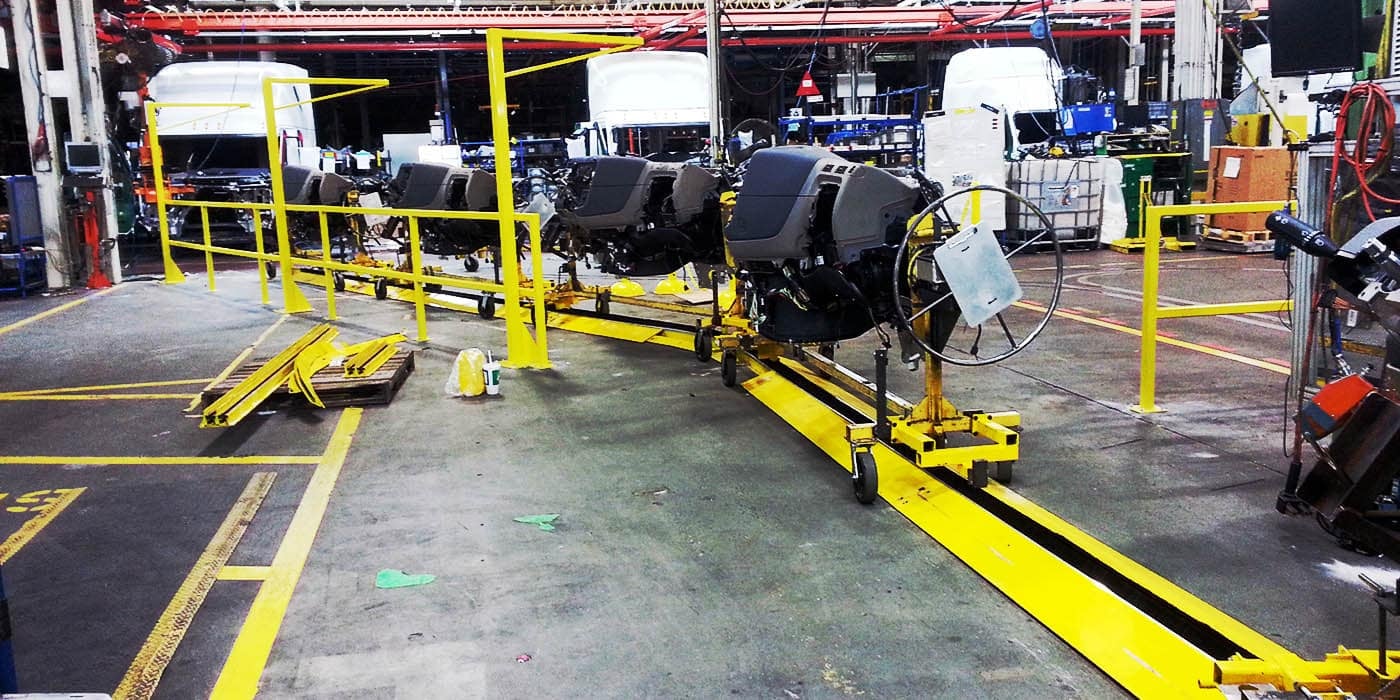
Inverted Monorail Conveyor Systems
Inverted monorail conveyor systems for compact floor-mounted guided movement where overhead structure, ceiling clearance, or product access makes a traditional overhead route less attractive.
A Monorail Conversation When Overhead Is Not The Answer
Inverted monorail conveyor systems can be useful when a plant needs guided carrier movement but overhead structure, ceiling clearance, product access, or process layout makes a hanging conveyor less practical.
IMH treats inverted monorail as a specialized floor-mounted option for compact routes, production cells, subassemblies, fixtures, and repeatable movement where a full inverted power and free system may be more control than the process needs.
Where Inverted Monorail Fits
Restricted Overhead Space
A floor-mounted guided path may help when roof steel, ceiling clearance, utilities, or overhead access limit a suspended conveyor.
Compact Carrier Movement
Useful for smaller assemblies, fixtures, tooling, components, or cells that need repeatable guided movement.
Simpler Than Full Power And Free
A monorail-style path may fit when the process needs guided movement but not complex accumulation or multi-route carrier logic.
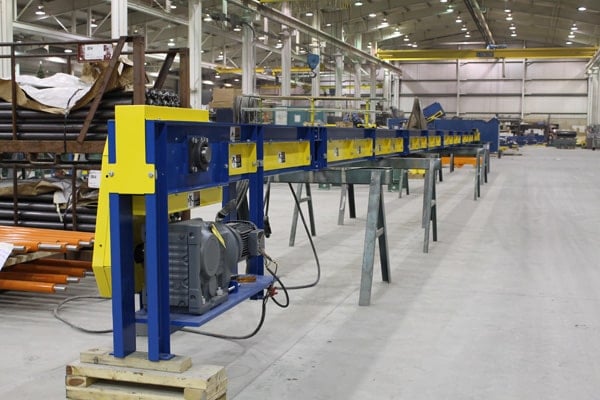
Inverted Monorail vs Inverted Power And Free
Inverted monorail is best understood as a compact guided floor-mounted conveyor option. It can support repeatable movement through a defined route when the process does not need the full switching, accumulation, carrier ID, and routing behavior of inverted power and free.
If the process requires independent carrier decisions, accumulation, sorting, rework routing, or complex indexing, inverted power and free may be the better discussion. If the goal is heavy cart movement through assembly, towline may be the stronger option.
Start With A Buildable Plan
Before budget, downtime, or engineering time is committed, the right project details need to be clear. IMH connects the desired outcome with the field conditions that decide whether the system can be installed cleanly and perform reliably after startup.
That means collecting photos, drawings, measurements, production goals, safety requirements, shutdown limits, and maintenance concerns early. It also means explaining tradeoffs in plain language: what should be engineered now, what can be phased later, what needs structural review, and what information is still missing before a final recommendation is responsible.
Inverted Monorail Inputs
These details help determine whether inverted monorail, inverted power and free, towline, or overhead conveyor is the better fit.
| Input | Why it matters |
|---|---|
| Load and fixture | Defines carrier design, support points, stability, and guided movement requirements. |
| Route complexity | Shows whether the process needs a simple guided path or more advanced switching and routing. |
| Overhead constraints | Identifies roof steel, ceiling height, utilities, cranes, or obstructions that may make overhead conveyor difficult. |
| Access requirements | Reviews operator, robot, maintenance, inspection, and tooling access around the product. |
| Movement behavior | Determines whether continuous, indexed, cyclic, or manually supported movement is required. |
| Floor and guarding | Plans track support, anchors, protection, safety, cleaning, and service access. |
| Future changes | Considers expansion, rerouting, product changes, and relocation needs. |
Best-Fit Uses
Inverted monorail fits best when the route is compact and the process needs guided movement more than heavy cart towing.
Choose The Architecture Before The Product Name
Inverted monorail, inverted power and free, towline, and overhead conveyor can all sound similar in early conversations because they move work through a route. The difference is in access, control behavior, load, floor-space impact, structure, and installation scope.
IMH reviews the process first, then narrows the architecture. That avoids forcing a customer into a conveyor style that looks good on paper but creates access, maintenance, or flow problems after installation.
The Work IMH Is Built Around
IMH Systems is focused on engineered movement overhead, reliable lifting, and field execution inside real manufacturing plants. Overhead conveyors, bridge cranes, and service or installation work remain the center of that story, while secondary equipment is included only where it helps solve the larger project.
Buyers get practical answers instead of generic product language: what details matter, what decisions affect the installed system, what tradeoffs need review, and when a project is ready for a deeper conversation.
For conveyor projects, that means reviewing load weight, carrier behavior, drive and take-up locations, controls, support steel, access below the line, maintenance points, and shutdown phasing before recommending a path.
A strong system can be quoted responsibly, installed cleanly, and serviced after startup.
A Practical Specialized Option
Inverted monorail expands the conversation for customers who need floor-mounted guided movement, but it should be selected carefully.
IMH keeps the decision practical: overhead conveyors free floor space, towline handles heavy cart movement, inverted power and free handles carrier control, and inverted monorail supports compact guided movement when that architecture fits.
A compact guided route can be powerful when it solves the exact access and movement problem in front of it.
Frequently Asked Questions
What is an inverted monorail conveyor?
It is a floor-mounted guided conveyor concept that moves carriers or fixtures through a defined path instead of suspending the load from overhead track.
When should inverted monorail be considered?
When overhead structure, ceiling clearance, access needs, or compact production-cell layout makes a traditional overhead route less practical.
How is it different from inverted power and free?
Inverted monorail is generally a simpler guided path. Inverted power and free is stronger when carriers need stopping, routing, accumulation, indexing, or more complex controls.
How is it different from towline?
Towline is usually focused on carts and heavy assembly movement. Inverted monorail is more about guided carrier movement in compact or access-sensitive applications.
What should I send IMH?
Send load details, fixture concept, route sketch, space constraints, overhead constraints, access needs, photos, and process goals.
Ready To Review An Inverted Monorail Conveyor?
Send IMH your route, load, fixture, access needs, overhead constraints, and photos so the right conveyor architecture can be reviewed.