

Power & Free Conveyor System Quote Guide
A practical Power & Free conveyor system quote guide for manufacturers planning accumulation, carrier routing, process timing, paint and finishing flow, assembly work, controls, support steel, and installation scope.
Power & Free Quotes Need More Than A Conveyor Name
A strong Power & Free conveyor quote starts with the work the carrier must perform. The system may need to stop, release, accumulate, switch, transfer, index, dwell, route through process equipment, or queue before load and unload zones.
IMH uses the quote conversation to connect carrier behavior with the plant around it: part weight, carrier style, route, elevation, process timing, support steel, controls, installation access, shutdown windows, and startup expectations.
Quote Details That Change The System
Carrier Behavior
Define where carriers move, stop, accumulate, dwell, transfer, switch, route, and release through the process.
Load And Process
Part weight, dimensions, finish sensitivity, carrier design, takt time, oven dwell, booth timing, and station work affect the right family.
Controls And Field Work
Stops, sensors, panels, interlocks, support steel, access, shutdowns, commissioning, and startup should be part of the quote early.
A Better First Call Creates A Better Proposal
Power and free systems often compete against simpler conveyor quotes. The difference is that the better system is designed around what production actually needs the carriers to do after startup.
When buyers send the right inputs, IMH can separate the true requirements from assumptions and compare enclosed-track power and free, two-rail power and free, heavier-duty power and free, I-beam, towline, or retrofit paths without forcing the wrong architecture into the plant.
Start With A Buildable Plan
Before budget, downtime, or engineering time is committed, the right project details need to be clear. IMH connects the desired outcome with the field conditions that decide whether the system can be installed cleanly and perform reliably after startup.
That means collecting photos, drawings, measurements, production goals, safety requirements, shutdown limits, and maintenance concerns early. It also means explaining tradeoffs in plain language: what should be engineered now, what can be phased later, what needs structural review, and what information is still missing before a final recommendation is responsible.
Power & Free Conveyor Quote Inputs
These details help define the correct conveyor family, carrier layout, controls package, support steel, and installation plan.
| Quote input | What IMH reviews |
|---|---|
| Part weight and dimensions | Weight, size, center of gravity, temperature, finish sensitivity, and how the part must be supported. |
| Carrier or load-bar concept | Hooks, racks, load bars, trolley count, carrier spacing, rotation, masking, product protection, and operator access. |
| Process timing | Line speed, takt time, dwell time, cure time, washer/booth/oven timing, inspection, rework, and unload windows. |
| Accumulation and buffering | Where carriers need to queue, stop, release, index, or protect downstream equipment from starvation or overload. |
| Switches and transfers | Branch paths, storage loops, work loops, bypasses, load switches, unload switches, and route decisions. |
| Drive and take-up plan | Chain pull, drive location, fixed or variable speed, overload protection, take-up access, and maintenance space. |
| Controls and interlocks | Stops, actuators, sensors, carrier detection, operator stations, panels, safety devices, and process-equipment handoff. |
| Support steel and access | Column layout, bracing, open floor access, maintenance reach, future expansion, and installation quality. |
| Install and startup window | Shutdown timing, preassembly, lift access, tie-ins, dry runs, loaded testing, training, and punch-list handoff. |
Best-Fit Quote Scenarios
A Power & Free conveyor quote is strongest when controlled carrier behavior creates clear value for production.
Support Steel Belongs In The Power & Free Quote
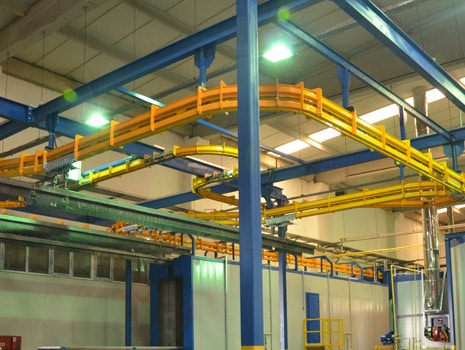
Power and free systems are valuable because they improve production flow. That value can disappear if support columns, bracing, drives, take-ups, controls, or access points block the floor below the conveyor.
IMH reviews support steel with the carrier route so the finished system protects forklift paths, operator movement, maintenance access, future expansion, and the professional appearance of the installation.
The Work IMH Is Built Around
IMH Systems is focused on engineered movement overhead, reliable lifting, and field execution inside real manufacturing plants. Overhead conveyors, bridge cranes, and service or installation work remain the center of that story, while secondary equipment is included only where it helps solve the larger project.
Buyers get practical answers instead of generic product language: what details matter, what decisions affect the installed system, what tradeoffs need review, and when a project is ready for a deeper conversation.
For conveyor projects, that means reviewing load weight, carrier behavior, drive and take-up locations, controls, support steel, access below the line, maintenance points, and shutdown phasing before recommending a path.
A strong system can be quoted responsibly, installed cleanly, and serviced after startup.
Power & Free Quote Guidance From Real Project Needs
IMH has documented overhead conveyor and power and free project experience nationwide, including carrier control, custom carriers, retrofit work, support steel, and installation planning.
This guide gives buyers a clean way to send the details that decide whether power and free is the right system, what family should be reviewed, and what field scope needs to be included.
A Power & Free conveyor quote should describe how the plant will control work, not just how the chain will move.
Frequently Asked Questions
What information is needed for a Power & Free conveyor quote?
Send load details, carrier needs, route, process zones, dwell time, accumulation needs, controls expectations, photos, drawings, and installation timing.
How is Power & Free different from a continuous conveyor?
Power and free allows carriers to stop, accumulate, transfer, route, or release independently from simple continuous chain movement.
Can Power & Free conveyor be used for paint lines?
Yes. Paint and finishing lines often use power and free concepts for washers, booths, ovens, cure zones, inspection, and controlled dwell time.
What determines Power & Free conveyor capacity?
Capacity depends on conveyor family, carrier design, trolley count, load bars, level or inclined travel, switches, chain pull, support steel, and controls.
Do controls affect the quote?
Yes. Stops, switches, sensors, actuators, panels, operator stations, interlocks, and commissioning can materially change scope.
Should support steel be included early?
Yes. Support layout affects floor access, installation quality, maintenance, future expansion, and how professional the finished system feels.
Ready To Build A Power & Free Quote Package?
Send IMH your load details, route, process timing, photos, drawings, controls needs, and shutdown window so the right Power & Free conveyor path can be reviewed.