
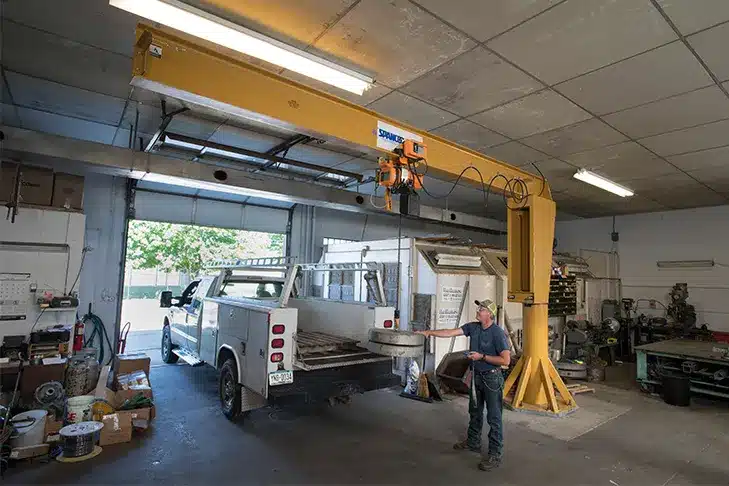
Jib Cranes and Gantry Cranes
Jib crane and gantry crane planning for localized lifting, maintenance handling, flexible coverage, and production support where a full bridge crane is not the right fit.
Not Every Lift Needs A Bridge Crane
Jib cranes and gantry cranes can be strong solutions when a plant needs localized lifting, maintenance support, portable coverage, or a simpler path than a full runway system.
IMH helps compare jib, gantry, workstation, underhung, and bridge crane options around load, reach, floor condition, obstructions, power, and installation access.
Choosing The Right Local Lift
Jib Cranes
Useful for swing coverage around a machine, workstation, or maintenance area.
Gantry Cranes
Useful when portable or freestanding lift coverage is needed.
Bridge Alternatives
Workstation or bridge cranes may be better when coverage, duty, or repeatability increases.
Start With The Work, Not The Crane Name
The best local lift depends on where the load starts, where it moves, how often it is lifted, and what is under or around it.
IMH reviews reach, rotation, travel path, floor condition, anchoring, clearances, controls, and installation timing before recommending a lifting approach.
Start With A Buildable Plan
Before budget, downtime, or engineering time is committed, the right project details need to be clear. IMH connects the desired outcome with the field conditions that decide whether the system can be installed cleanly and perform reliably after startup.
That means collecting photos, drawings, measurements, production goals, safety requirements, shutdown limits, and maintenance concerns early. It also means explaining tradeoffs in plain language: what should be engineered now, what can be phased later, what needs structural review, and what information is still missing before a final recommendation is responsible.
Jib And Gantry Quote Inputs
These inputs help IMH compare local lifting options.
| Input | Why it matters |
|---|---|
| Load weight | Determines crane, hoist, support, and foundation needs. |
| Required reach | Sets jib boom length, gantry span, or alternate crane coverage. |
| Lift height | Confirms usable hook travel and clearances. |
| Floor condition | Important for anchors, foundations, slab condition, and gantry movement. |
| Rotation or travel | Clarifies jib swing, gantry wheel path, locks, operating zones, and nearby traffic. |
| Use frequency | Changes duty, controls, and hoist selection. |
| Work area constraints | Identifies machines, aisles, doors, utilities, and access issues. |
Best-Fit Uses
Jib and gantry cranes are often strongest where the lifting need is focused.
Anchors And Floor Conditions Matter
Jib and gantry cranes can look simple, but anchor loads, floor condition, reach, rotation, wheel path, stability, and load path still matter.
IMH reviews the installed environment so the crane does not create a safety, access, maintenance, or usability problem.
The Work IMH Is Built Around
IMH Systems is focused on engineered movement overhead, reliable lifting, and field execution inside real manufacturing plants. Overhead conveyors, bridge cranes, and service or installation work remain the center of that story, while secondary equipment is included only where it helps solve the larger project.
Buyers get practical answers instead of generic product language: what details matter, what decisions affect the installed system, what tradeoffs need review, and when a project is ready for a deeper conversation.
For bridge crane and overhead lifting projects, that means reviewing capacity, span, hook coverage, runway support, lift height, duty cycle, controls, electrification, building structure, access below the crane, and installation phasing before recommending a path.
The result should be a crane system that can be quoted responsibly, installed cleanly, aligned correctly, operated confidently, and serviced after startup.
Local Lifting Application Evidence
IMH helps buyers avoid overbuying or underbuying lifting equipment by comparing the work against real crane options.
The right lifting choice should improve handling without creating new floor problems.
A small crane still deserves a serious layout review.
Frequently Asked Questions
When is a jib crane better than a bridge crane?
When the lifting need is localized around one machine, cell, or work area.
When is a gantry crane useful?
When freestanding or movable lifting coverage is needed.
Can IMH help compare options?
Yes. IMH can compare jib, gantry, workstation, underhung, and bridge crane approaches.
What information is needed?
Load weight, reach, lift height, floor condition, photos, and work process details.
Can IMH install the crane?
Yes. IMH can help plan anchors, access, power, and startup needs.
Ready To Compare Local Lifting?
Send IMH your load, reach, photos, and the work area you need covered.